
Who used butter in antiquity?
Although butter consumption was first mentioned in Mediterranean antiquity, it was not widely used in food preparation, as people preferred cooking with oil, but was more appreciated for therapeutic reasons.
Egyptians used it as a remedy for eye irritations.
The Romans made butter only very occasionally, but generally they did not eat it. When they did use butter, it was to put on a wound, as we do on a burn, which is not the right thing to do, by the way. If you take a first aid course nowadays, you will be strongly cautioned about that.
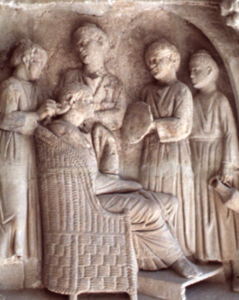
Roman stele depicting a ‘Cosmetae‘ applying cosmetics to a wealthy Roman woman
Romans, like the Greeks, used it as a cosmetic not only to soften their skin but also to shine their hair by massaging their head with it. They also enjoyed its medicinal properties to soothe coughs or aching joints, combat skin infections, and soothe burns. It is said that the Ancient Romans cured pimples with a mixture of barley flour and butter.
Note that Romans and Greeks were aware that some people were lactose intolerant. In the Hippocratic book “On Ancient Medicine”, the writer wrote that some people suffered if they ate even a small amount of cheese, and the writer Celsus (in De Medicina 2 21) said that cheese can cause flatulence and constipation.
Clarified butter and ghee
Clarified butter is butter with almost all of its water and milk solids removed, leaving almost pure butterfat.
Ghee is clarified butter that has been heated to around 120 °C (250 °F) after the water evaporates, turning the milk solids brown
Note on traditional butter versus ghee: Typically, if someone has a dairy intolerance, it is an intolerance to casein (a protein in milk) and lactose (a natural sugar in dairy products and whey). Ghee contains neither.
When prepared in the tradition of Ayurveda, the casein and lactose are removed, therefore making ghee tolerable for those who can’t eat dairy otherwise!
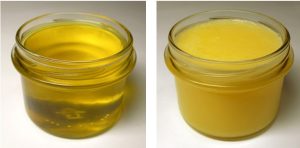
Ghee freshly prepared versus ghee at room temperature.
How old long can butter survive?
Ireland has a rich history linked with butter from very early on and we saw in blog # 2 that Ireland uncovered, not so long ago, a 2000 years old lump of butter that had been buried in a bog.
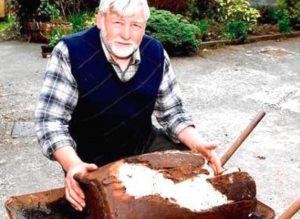
Butter in a firkin discovered buried in an Irish bog
Butter found in a firkin buried in an Irish bog
Did you know, however, that the oldest butter mold was found in 2013 in a bog (again) of the Irish county of Offaly? It is dated at five thousand years old and would therefore be 3000 BC!
Expansion throughout Asia:
The first documented mention of butter making was in the sacred songs of the dwellers of Asiatic India, dating back to 1,500-2,000 B.C.E. There is historical mention of ancient tribes creating primitive churns by horizontally agitating cow, yak and horse milk.
Butter, back then, was not only eaten, but also served as an illumination oil, used for medicinal purposes, and tribe members would coat their skin with it to insulate from the harsh winter cold.
The expansion of the northern Asian tribes by conquest and colonization brought butter to the inhabitants of southern Asia. However, butter in southern climates could not be stored as easily as it could in the frozen northern plains. The southerners were the first to clarify butter to keep the fat from spoiling.
The importance of butter in Hindu culture? Cows being sacred, butter is the only animal fat Hindus will eat.
The long living Hunza tribe members

The Hunza Valley in the Himalayas
The Hunza tribe, who live in the remote Himalayan Hunza valley between Pakistan, India, and China, are said to live rather regularly to the ripe ages of 110 to 120 years.
Their vitality has been attributed to a culture-rich diet of butter, kefir and yogurt, along with plenty of whole grains.